Wednesday, August 25, 2010

6NA Narrogin WA 918 kHz QSL


It was a pleasant surprise to hear 6NA Narrogin WA on 918 khz for the first time during the exceptional reception conditions on the 27th June 1986 via the FRG7 and 30 metre longwire antenna at Sandbaai.

I received a friendly QSL letter from Radio Technician Peter Brown who kindly responded to my reception report.


The checkered Bunbury lighthouse was built in 1959. The original lighthouse was subsequently attached to the top of the 10 metre base extension which was constructed in 1971 (Photograph Wikimedia Commons).

Tuesday, August 24, 2010

6GE Geraldton WA 1008 kHz QSL


It was a pleasant surprise to hear 6GE Geraldton WA on 1008 khz for the first time during the exceptional reception conditions on the 27th June 1986 via the FRG7 and 30 metre longwire antenna at Sandbaai.

I received a QSL letter from General Manager Lyle J. Harris who kindly verified to my reception report.


Coronation Beach, just north of Geraldton WA, is a popular windsurfing location (Photograph Wikimedia Commons).

Tuesday, August 17, 2010

2CH Sydney NSW 1170 kHz QSL


It was a pleasant surprise to hear 2CH Sydney on 1170 khz for the first time (A South African First) during the exceptional reception conditions on the 25th June 1986 via the FRG7 and 30 metre longwire antenna at Sandbaai.

I received a QSL card, letter, bumper stickers and promo pamphlet from Network Chief Engineer Alan Liddelow who kindly responded to my reception report.


The 2CH "9 O'Clock Specials" promo pamphlet for August 1986.

One of the old 2CH antenna towers at Ermington, New South Wales (Photograph Wikimedia Commons).

The old 2CH transmitter building and antenna towers at Ermington New South Wales (Photograph Wikimedia Commons).

Saturday, August 14, 2010

5PI Port Pirie SA 1044 kHz QSL


It was a pleasant surprise to hear 5PI Port Pirie for the first time on the 25th June 1986 via the FRG7 and 30 metre longwire antenna at Sandbaai.

I received a QSL card, letter and bumper stickers from Chief Engineer Richard Kruger who kindly responded to my reception report. Richard added that in the 4 and a half years that he had been with the station, this was the first report received from the Continent of Africa - a reflection of superb reception conditions experienced at an ideal coastal location!

The station changed their callsign to 5CS in 1987.


The former Port Pirie railway station. The impressive Victorian pavilion-style building was built in 1902 and is now a museum (Photograph Wikimedia Commons).

Thursday, August 12, 2010

KRGV Weslaco TX 1290 kHz QSL


It was a pleasant surprise to hear KRGV Weslaco TX on 1290 kHz on the 25th June 1986 via the FRG7 and 30 metre longwire antenna at Sandbaai. The music request phone-in programme was heard until fade out at 0645 hours UTC that morning - the latest that I managed to hear a mediumwave radio station from the U.S.A. at the time.

I received the friendly and informative QSL letter with a station sticker from Chief Engineer Lawson Campbell who kindly responded to my reception report.

Tuesday, August 10, 2010

6IX Perth WA 1080 kHz QSL


It was a pleasant surprise to hear 6IX Perth for the first time on the 24th June 1986 via the FRG7 and 30 metre longwire antenna at Sandbaai. The 2 kw signal was received with consistent good peaks that evening.

I received the above QSL letter and microphone stickers from Chief Engineer Alan D'Mello who kindly responded to my reception report.

Friday, August 6, 2010

NEW ZEALAND 4ZB Dunedin 1044 kHz QSL + Audio


The sensational appearance of 4ZB Dunedin, New Zealand on 1044 kHz on the 25th and 26th June 1986 via the FRG7 and a modest 30 metre longwire antenna at Sandbaai, South Africa, was a remarkable and rare occurrence.

To the best of my knowledge New Zealand has not been logged on the mediumwave band in South Africa since.


The 4ZB envelope with the enclosed QSL card was received in response to my reception report and was a cause for great celebration!

Audio Clip


The recording was made at 1724 UTC on the 25th June 1986 and included a "time check" announced as "five and a half away from the 5:30 news" as well as a promo for "Replay Radio".

Polar Absorption

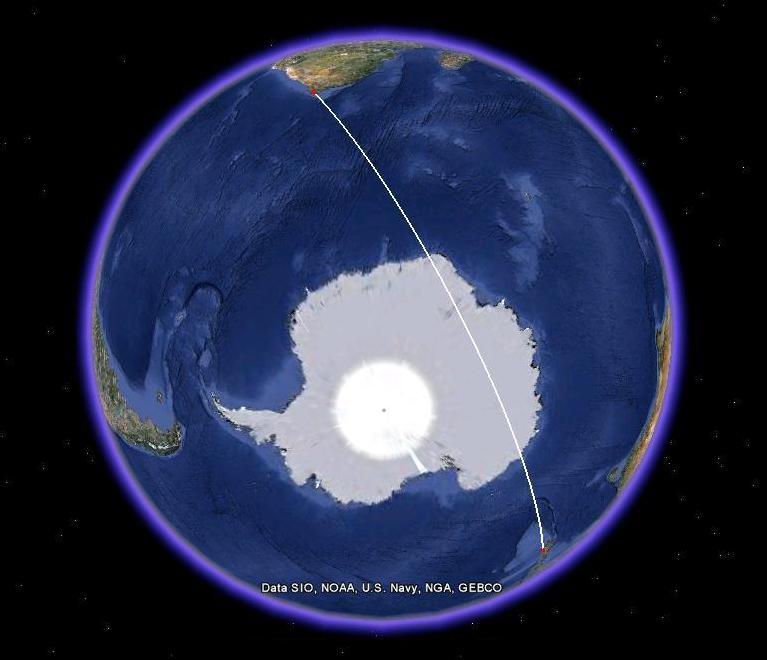
The proximity of the signal path to the South Pole would help explain the rare appearance of a New Zealand mediumwave station in South Africa.

Google Earth Image showing the 10 646 km great circle path between Dunedin, New Zealand and Sandbaai, South Africa.

Polar absorption seems to reduce the ability of signals from the more southerly latitudes to reach here. It would appear that quiet ionospheric conditions with very low A/K indices are essential in order to receive dx signals from the south east part of Australia and New Zealand.

My guess is that the zero sunspot count with the quiet geomagnetic field on the 25th and 26th June 1986 would have contributed greatly to the reception of 4ZB.

Google Earth Image showing the ZB 1044 kHz 122 metre antenna mast at Highcliff to the east above Dunedin (Click onto the image for a high resolution).

Wednesday, August 4, 2010

WAME Charlotte NC 1480 kHz QSL


It was a pleasant surprise to hear WAME on 1480 kHz for the first time (A South African First) on the 4th June 1986 via the FRG7 and 30 metre longwire antenna at Pinelands.

I received the above QSL letter from Chief Engineer Fred Roberts who kindly responded to my reception report. Fred indicated that this was their first report from South Africa and quite possibly the most distant.

After many call sign and ownership changes, the station is now operating as WGFY 1480 Radio Disney, presently owned by the ABC.

Thursday, July 29, 2010

WWL New Orleans LA 870 kHz QSL


WWL New Orleans LA on 870 kHz was heard on the 14th May 1986 via the FRG7 and 30 metre longwire antenna at Pinelands.

WWL Director Of Technical Services Hugh Burney kindly responded to my reception report to the station.

Hurricane Katrina

WWL was one of the few radio stations to remain on air in the area during the immediate effects and aftermath of Hurricane Katrina on New Orleans and the Gulf Coast in late August 2005. Announcer Garland Robinette kept broadcasting for a time from an improvised studio built in a closet after the studio's windows were blown out.

Wednesday, July 28, 2010

KWKH Shreveport LA 1130 kHz QSL


It was a pleasant surprise to hear KWKH on 1130 kHz for the first time (A South African First) on the 12th May 1986 via the FRG7 and 30 metre longwire antenna at Pinelands.

I was fortunate to receive the above QSL form letter in response to my reception report.

Tuesday, July 27, 2010

WOAI San Antonio TX 1200 kHz QSL


WOAI San Antonio TX on 1200 kHz was heard on the 5th May 1986 via the FRG7 and 30 metre longwire antenna at Pinelands.

I was fortunate to receive the above QSL card in response to my reception report.

Thursday, July 22, 2010

KFI Los Angeles CA 640 kHz QSL


KFI on 640 kHz was received at Sandbaai for the first time (A South African First) on the 22nd March 1986. It was a pleasant surprise to hear the station over a remarkable distance of 16 091 km via the FRG7 and 30 metre longwire antenna.

I was fortunate to receive the above QSL card and car bumper sticker in response to my reception report.


An early 1940's photograph of the KFI/KECA studios, located at 141 North Vermont Avenue. KFI remained in The Morgan, Walls and Clements building until 1975 (Photograph with kind permission from Barry Mishkind whose interesting and informative website www.oldradio.com includes additional images and recollections from KFI's early days).

Tuesday, July 20, 2010

U.K. BBC Radio 2 909 kHz QSL and Audio

BBC Radio 2 on 909 kHz used to be a regular guest at Pinelands during the 1980's. 

The above QSL card was received in response to my reception report from the 4th March 1986. 


A recording of the reception has been preserved and is available here or by clicking onto the play icon below :
  
The recording was made at 0100 UTC on the 4th March 1986 via the FRG7 and 30 metre longwire antenna at Pinelands.

Friday, July 16, 2010

6RN Busselton WA 1269 kHz QSL


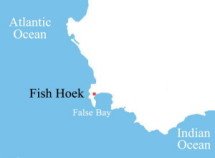
6RN Busselton WA was heard on a new frequency of 1269 kHz on the 28th June 2010 at Fish Hoek. The station has been transmitting on 1269 khz (ex 1224 kHz) since 13th April 2010.

Graham from ABC Master Control kindly responded to my reception report :

Hi Gary,

I can confirm your reception of Radio National broadcasting from Busselton on the new frequency of 1269 kHz at 1700Z on 28th June, 2010. This service changed frequency on April 13 this year to make way for a new News Radio service operating on 1152kHz which has just commenced test transmissions.

The Busselton transmitter site is located at 33 39 40S / 115 13 40E with Radio National 1269kHz operating at a power of 5kW in an omnidirectional radiation pattern (this may be varied in the future depending on the 1152Khz News Radio tests).

Kind regards,

Graham

Tuesday, June 29, 2010

ABC Radio National Busselton WA on 1269 khz (ex 1224 kHz)


ABC Radio National, Busselton WA was heard on a new frequency of 1269 kHz at Fish Hoek this week. The station has been transmitting on 1269 khz (ex 1224 kHz) since 14th April 2010.

The following notice was posted on the ABC website :

New Frequency for Radio National from 14 April 2010

The ABC would like to advise listeners the Radio National service broadcasting from Busselton will relocate from 1224 AM to 1269 AM in the early hours of the morning on 14 April . All listeners will need to retune their radio from this date to continue to receive their Radio National broadcast.

This frequency change is necessary to prepare for the introduction of ABC News Radio to the region later this year.

It is important to note, there will be no frequency changes to any other ABC radio broadcasts.

Google Earth Image of the 6RN ABC Radio National 183 metre mast at Busselton (33° 39' 39"S, 115° 13' 39"E). The mast is situated approximately 500 metres from the coast.

Friday, June 25, 2010

ABC News Radio Busselton WA Test Transmission on 1152 kHz

A test transmission from the Australian Broadcasting Corporation was heard at Fish Hoek this week. The transmission is being broadcast from Busselton WA on 1152 kHz and is a new proposed ABC News Radio service for the Bunbury-Busselton area. 

A loop of the following pre-recorded announcement by ABC News Radio Breakfast announcer Glen Bartholomew was heard over a music bed : 

" ... Hi. I'm Glen Bartholomew, breakfast presenter with ABC News Radio and this is a test transmission for ABC News Radio in the Bunbury-Busselton area on 1152 AM. If you think this test transmission is interfering with other broadcasts please contact the ABC's Reception Advice Line on 1300 13 9994 - that's 1300 13 9994. ABC News Radio will commence broadcasting on this frequency once the test transmission is complete. If you would like to know more about ABC News Radio, why not visit our website at abc.net.au/newsradio. Thanks for listening and make sure you spread the news ... " 

An audio clip of the announcement heard at Fish Hoek during the evening of the 23rd June 2010 is available here or by clicking onto the play icon below :

 
The test transmission, heard via the Sony SRF-M37V and 220 metre BOG directed towards Perth WA, was verified this morning by Graham from ABC Master Control. 

Hi Gary, I am happy to confirm your reception of our test transmission on 1152kHz at 1935UTC on June 23 of our new News Radio service at Busselton, Western Australia. Unfortunately being a test service I don't have details of the transmitter for you, but can confirm your reception report. I'm also impressed you've managed to feed a beverage antenna into a portable radio without overloading it - well done! Regards, Graham 

The Australian Federal Government has pledged additional funding for the expansion of new ABC News Radio services into all centres around the country with populations of more than 10,000 (subject to the availability of spectrum) and will include over 80 frequencies by the end of 2010, according to the ABC News Radio website. ABC NewsRadio is the Australian Broadcasting Corporation's national radio network providing continuous news and information 24 hours a day.

Wednesday, June 23, 2010

WKIX Raleigh NC 850 kHz QSL and Audio

The interesting QSL letter and bumper sticker was received from Chief Engineer Steven Boucher who kindly verified my report. 

WKIX on 850 kHz made it through to Pinelands for the first time (A South African First) on the 24th January 1986. 

The station turned out to be a rare guest - to the best of my knowledge WKIX has not been logged in South Africa since. 

Chief Engineer Steven Boucher was surprised to receive my reception report and indicated that this was the first dx report received from outside the U.S.

Audio 

The original cassette tape recording of the reception has fortunately been preserved. A brief extract of the recording is available here or by clicking onto the play icon below.

 
The recording was made at 0339 UTC on the 24th January 1986 and consists of a time check for 10:39 in addition to two WKIX ids during a promo for a high school basketball match, between Smithfield-Selma and Athens Drive, that was due to occur at 7:45 pm on Friday that week.

Tuesday, June 22, 2010

WHDH Boston MA 850 kHz QSL


WHDH Boston MA on 850 kHz was heard on the 24th January 1986 via the FRG7 and 30 metre longwire antenna at Pinelands.

Broadcast Engineer Alan Carp kindly responded to my reception report with a friendly verification letter, QSL card, stickers and information brochures.


WHDH information brochures were included with the reply in 1985.

WHDH operated on 850 kHz until August 1994 when it signed off permanently and was replaced by WEEI.

Sunday, June 20, 2010

U.K. LBC London 1152 kHz QSL and Audio


It was a pleasant surprise to hear LBC London on 1152 kHz for the first time (A South African First) on the 13th November 1985 via the FRG7 and 30 metre longwire antenna at Pinelands.

Head of Engineering, Roger Francis, kindly responded to my reception report with a QSL card (on which "record distance" was indicated), sticker and station brochure.


Google Earth image showing LBC's 23.5 kw signal path from Saffron Green across the African continent to Pinelands (a distance of 9 648 km).


The LBC brochure above was received with the QSL in 1985.

AUDIO CLIPS also available on the right hand side of the web page.

The first recording of a weather report for London and an advertisement for a car auction establishment was made on the 13th November 1985 via the FRG7 and 30 metre longwire antenna at Pinelands.

The second recording of a clear LBC id was made on the 6th June 1988 via the FRG7 and 1 km beverage antenna at Swartriet.